

- 8Critical
- 105Important
- 0Moderate
- 0Low
Microsoft addresses 113 CVEs in the first Patch Tuesday of 2026, with two zero-days, including one that was exploited in the wild. Microsoft patched 113 CVEs in its January 2026 Patch Tuesday release, with eight rated critical and 105 rated as important. Our counts omitted one CVE that was assigned by MITRE, CVE-2023-31096. 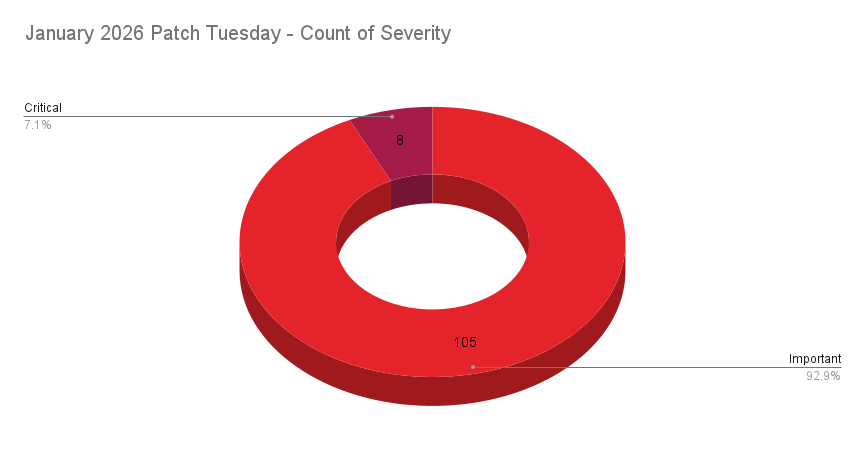 This month’s update includes patches for: Azure Connected Machine Agent Azure Core shared client library for Python Capability Access Management Service (camsvc) Connected Devices Platform Service (Cdpsvc) Desktop Window Manager Dynamic Root of Trust for Measurement (DRTM) Graphics Kernel Host Process for Windows Tasks Inbox COM Objects Microsoft Graphics Component Microsoft Office Microsoft Office Excel Microsoft Office SharePoint Microsoft Office Word Printer Association Object SQL Server Tablet Windows User Interface (TWINUI) Subsystem Windows Admin Center Windows Ancillary Function Driver for WinSock Windows Client-Side Caching (CSC) Service Windows Clipboard Server Windows Cloud Files Mini Filter Driver Windows Common Log File System Driver Windows DWM Windows Deployment Services Windows Error Reporting Windows File Explorer Windows HTTP.sys Windows Hello Windows Hyper-V Windows Installer Windows Internet Connection Sharing (ICS) Windows Kerberos Windows Kernel Windows Kernel Memory Windows Kernel-Mode Drivers Windows LDAP – Lightweight Directory Access Protocol Windows Local Security Authority Subsystem Service (LSASS) Windows Local Session Manager (LSM) Windows Management Services Windows Media Windows NDIS Windows NTFS Windows NTLM Windows Remote Assistance Windows Remote Procedure Call Windows Remote Procedure Call Interface Definition Language (IDL) Windows Routing and Remote Access Service (RRAS) Windows SMB Server Windows Secure Boot Windows Server Update Service Windows Shell Windows TPM Windows Telephony Service Windows Virtualization-Based Security (VBS) Enclave Windows WalletService Windows Win32K – ICOMP
 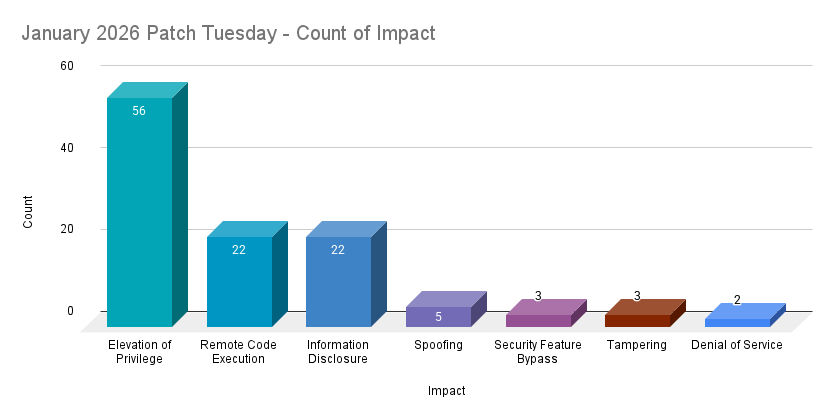 Elevation of privilege (EoP) vulnerabilities accounted for 49.6% of the vulnerabilities patched this month, followed by remote code execution (RCE) vulnerabilities at 19.5%.
CVE-2026-20805 – Desktop Window Manager Information Disclosure Vulnerability
CVE-2026-21265 – Secure Boot Certificate Expiration Security Feature Bypass Vulnerability
| Certificate Authority (CA) | Expiration Date | Purpose | Location |
|---|---|---|---|
| Microsoft Corporation KEK CA 2011 | June 24, 2026 | Signs updates to the DB and DBX | KEK |
| Microsoft Corporation UEFI CA 2011 | June 27, 2026 | Signs third party boot loaders, Option ROMs and more | DB |
| Microsoft Windows Production PCA 2011 | October 19, 2026 | Signs the Windows Boot Manager | DB |
This vulnerability is considered “Publicly Disclosed” because the information about the expiration and the location of these certificates are public.
CVE-2026-20952 and CVE-2026-20953 – Microsoft Office Remote Code Execution Vulnerability
CVE-2026-20840 and CVE-2026-20922 – Windows NTFS Remote Code Execution Vulnerability
Tenable Solutions
A list of all the plugins released for Microsoft’s January 2026 Patch Tuesday update can be found here. As always, we recommend patching systems as soon as possible and regularly scanning your environment to identify those systems yet to be patched. For more specific guidance on best practices for vulnerability assessments, please refer to our blog post on How to Perform Efficient Vulnerability Assessments with Tenable.
Get more information
Microsoft’s January 2026 Security Updates Tenable plugins for Microsoft January 2026 Patch Tuesday Security Updates Join Tenable’s Research Special Operations (RSO) Team on Tenable Connect and engage with us in the Threat Roundtable group for further discussions on the latest cyber threats. Learn more about Tenable One, the Exposure Management Platform for the modern attack surface. 
First seen on securityboulevard.com
Jump to article: securityboulevard.com/2026/01/microsofts-january-2026-patch-tuesday-addresses-113-cves-cve-2026-20805/


